

Red-tailed Hawk
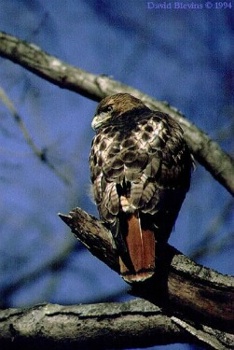
Red-tailed Hawk Information
Length: 18 - 25"
Habitat: Deciduous forests, mixed deciduous and coniferous forests; forest edges; open country such as fields, pastures, swampy areas. Prefers woodlots adjacent to or surrounded by open areas.
Diet: Small rodents such as voles, squirrels, mice, chipmunks; other small mammals, esp. cottontail rabbits, shrews, and moles; amphibians, reptiles; birds, esp. red-winged blackbirds; insects; carrion.
 Calls of the Red-tailed Hawk
 Red-tailed Hawk Nesting and Breeding
Interesting Facts about the Red-tailed Hawk
- The Red-tailed Hawk's main hunting technique is to sit on a perch and scan the surrounding area for prey. It is also known to hunt by flying back and forth over an area at a height of about 200 feet or less. This buteo's keen eyesight allows it to spot its prey from a great distance.
- Unlike the Osprey, which will nest very close to human activity, the Red-tailed Hawk is sensitive to human presence. If disturbed, especially during the incubation period, it may abandon its nest.
- Only those Red-tailed Hawks in the northern part of their range are long-distance migrants. Those in the middle latitudes will withdraw slightly southward in the fall, migrating much shorter distances.
Few Red-tailed Hawks are found in northern New England during the winter, but these birds are common in southern New England during this time. However, those particular hawks are most likely ones that have migrated from further north.
Red-tailed Hawk
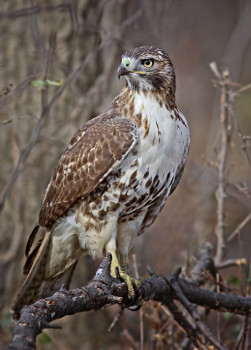
© Sanjibbhatt
Red-tailed Hawk
Identification Tips
- Wingspan: 48 inches
- Sexes similar
- Short, dark, hooked beak
- Large, broad-winged, broad-tailed hawk
- Immatures have notably narrower wings and tail, and appear slimmer
- Dark patagial mark on underwing, present on all ages and races, is unique
- Blocky translucent area in outer primaries
- Flies with a dihedral
- Extraordinary geographic variation
Light morph adult:
(Subspecies most commonly found in New England)
- Brown head, nape, back, and upperwings
- White chin, throat, breast, and belly
- Dark belly band formed by vertical streaks in band across belly
- White underwings have dark carpal bar on leading edge, dark outer primary tips and a dark trailing edge and are otherwise pale with dark bars on the flight feathers on all but the outermost primaries
- Tail appears brick red above and pink below
- Breast and back pattern vary with geography, with some birds being intermediate between light and dark morphs
(Credit: U. S. Geological Survey)
Red-tailed Hawk
Breeding Bird Survey Map,
2011-2015
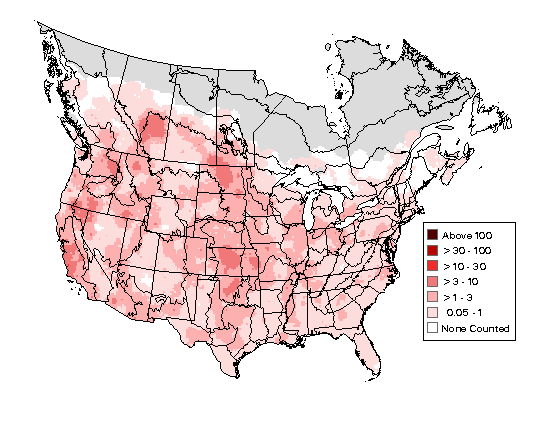
(Image credit: USGS)
Red-tailed Hawk
Range Maps from Cornell
Red-tailed Hawk breeding, migration, winter and year-round range
Includes separate map of sightings.
Red-tailed Hawk
Christmas Bird Count Map
Historical CBC Map from USGS