

Barred Owl
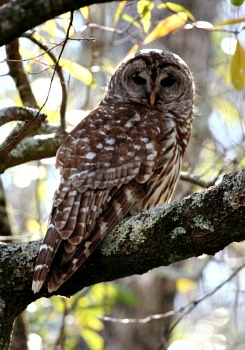
Barred Owl Information
Length: 17 - 24"
Habitat: Wooded areas - from swampy woods to drier, upland forests. Especially woods near streams, lakes, or river valleys. Prefers open woodlands or wooded areas near open country for hunting.
Diet: Small mammals, including mice (staple), shrews, voles, squirrels, chipmunks, hares, rabbits; birds, reptiles,
amphibians, crayfish, insects.
 Songs and calls of the Barred Owl
 Barred Owl Nesting and Breeding
Interesting Facts about the Barred Owl
- The Barred Owl is mostly nocturnal but it is not unusual to see or hear it during the daytime hours, especially in the late afternoon or on cloudy days.
- This owl hunts mainly from a perch. Like most owls, it swallows its prey whole and then returns to a more sheltered location. The indigestible materials - bones, fur, and other parts - form into pellets that the owl regurgitates each day. An owl's feeding perches can often be located by the pellets found on the ground below.
- When roosting during the day, the Barred Owl may be mobbed by crows, jays, chickadees, or other birds. Mobbing is thought to be either a means of driving the predator away, a way of diverting it from nesting areas, or a system for alerting other birds to the owl's presence.
- Barred Owls do not migrate but instead stay on their breeding grounds throughout the year. However, the male may sometimes leave during the winter if the food supply is not sufficient. It then returns in the spring to its nesting territory.
Barred Owl on Branch
Mark Musselman/USFWS
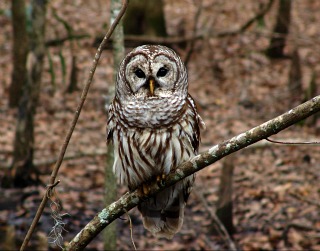
Barred Owl
Identification Tips
- Wingspan: 44 inches
- Sexes similar
- Rather large owl
- Dark eyes and yellow bill
- Back brown, mottled with pale spots and dark bars
- Underparts pale with long, brown streaks
- Chest pale with brown barring
- Face pale with dark concentric rings surrounding eye
(Credit: U. S. Geological Survey)
Barred Owl
Breeding Bird Survey Map,
2011-2015
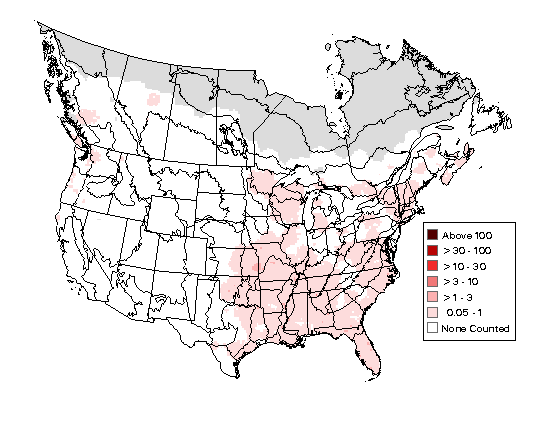
(Image credit: USGS)
New England Range
The Barred Owl is found year round throughout New England.
Barred Owl
Range Maps from Cornell
Barred Owl
year-round range
Includes separate map of sightings.
Barred Owl
Christmas Bird Count Map
Historical CBC Map from USGS